


The Secret to a Perfect Economic Boom according to Spirit of the Law
Are you tired of investing precious food and wood into economic upgrades only to wonder if they were worth the cost? Many players rely on conventional wisdom regarding eco techs, but mistiming your upgrades can lead to a sluggish economy and a loss of map control.
Incorrect technology prioritization often cripples resource collection efficiency, diverting resources that could have been used to create new villagers or military units. This inefficiency can leave you perpetually behind your booming opponent.
This guide from Spirit of the Law moves beyond simple rules of thumb, offering an analytical approach focused on payoff time—the duration required for an upgrade to recoup its initial resource cost. By understanding the specific ROI of each tech, you can make smarter decisions and secure your economic dominance.
Efficiency Matrix: Villager Thresholds for Optimal Payoff
Minimum number of units required for the technology to pay back the cost within the target time horizon.
| Upgrade |
 for Sub 8-Min Payoff (Minimum Acceptable)
|
for Sub 5-Min Payoff (Optimal Benchmark)
|
|---|---|---|

|
12
(Payoff 3–4 mins, high priority).
|
|

|
15
(Payoff around 4 mins).
|
|

|
21
(Payoff 5–9 mins).
|
50
(Requires extreme numbers).
|
 |
7–8
( payoff ~8 min). payoff ~8 min).
|
12–13
(Sweet spot for 5 min payoff).
|
 |
Fewer than 8 hard to justify. |
12–13
(Sweet spot for 5 min payoff).
|
 |
14 .
|
25 .
|
 |
15 .
|
27
(Rarely justifiable / Net loss).
|
 |
9–10
(Long-term payoff).
|
15+
(Conservative 5 min payoff).
|
 |
11
(Payoff under 5 minutes, automatic pickup).
|
|
 |
~50 Total .
|
~80
(or 30F/30W/20M setup).
|
*Note on Burgundians: This civilization achieves the same payoff times with approximately 30% fewer villagers due to reduced food costs.
 Why Wood Upgrades Are King: Lumber Camp Priority
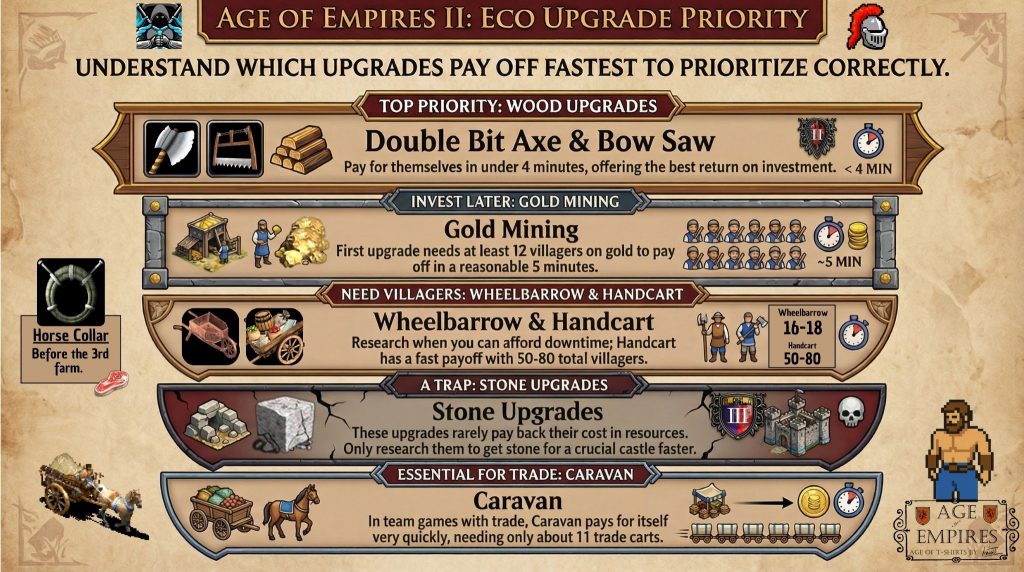
Lumber camp upgrades are almost universally considered the most crucial economic technologies, offering exceptionally fast returns compared to other upgrades.
The core principle here is simple: prioritize wood collection efficiency.
Double Bit Axe (100  , 50 ) is often hailed as the single most important economic upgrade you can get.
- ⏱️Payoff Time: With 12
 lumberjacks—a reasonable estimate for early-to-mid Feudal Age—the tech pays off in roughly three and a half minutes.
 - Priority: You should aim to pick this up universally in the Feudal Age, or immediately after clicking up to Castle Age in a fast castle build.
Bow Saw is more expensive and takes longer to research, but by this stage, you typically have more villagers on wood, which accelerates its payoff.
- ⏱️Payoff Time Benchmark: Assuming 15 lumberjacks, Bow Saw generally pays off in about four minutes. If you have 20 lumberjacks, this time drops to around 3 minutes and 15 seconds.
- Action: This quick return makes a strong argument for prioritizing Bow Saw whenever possible.
The final wood upgrade is substantially more expensive, takes longer to research, and offers only half the collection bonus of the previous tiers.
- ⏱️Payoff Time Range: With 21 to 50 lumberjacks (the typical extremes in Imperial Age), the payback time ranges from five to nine minutes.
- Conclusion: While it offers a great return on investment over the long run, it has a lower priority compared to Double Bit Axe and Bow Saw due to its slower initial payback.

 Analyzing Mining Camp Upgrades: Gold vs. Stone
The mining camp upgrades provide a smaller collection boost (15% vs. 20% for the first two wood techs) and generally exhibit significantly longer payoff times, especially in the Feudal Age.
If you are running double range archers, you might have 7 or 8 villagers on gold.
- ⏱️Initial Payoff Concern: With 7-8 villagers, the payoff time for the first tier of mining techs is approximately 8 minutes. This is quite long for a Feudal Age investment, which is why many players skip these techs early on.
- Sweet Spot: To achieve a respectable 5-minute payback, you need 12 or 13 miners. Anything fewer than eight miners makes the tech difficult to justify.
The Stone Mining Exception
Stone Mining efficiency is marginally slower than gold. However, the decision to get Stone Mining is often less about resource payback and more about tactical urgency.
- Castle Rush: If you are prioritizing a quick castle, researching Stone Mining just as you begin collection can reduce the time needed to gather 650 stone by about 30 seconds. This tactical advantage alone may justify the 175 resource cost.
 Gold Shaft Mining
To hit a sub-8 minute payback on Gold Shaft Mining, you need at least 14 villagers. Achieving the 5-minute benchmark requires closer to 25 gold miners.
Even late in the game, Gold Shaft Mining is often worth the investment, provided there is sufficient gold left on the map.
- Sustainability: The math suggests Gold Shaft Mining eventually pays for itself, provided you have at least 3,200 gold left to mine (equivalent to four gold tiles).
 Stone Shaft Mining
Stone Shaft Mining presents a much different scenario, requiring 15 miners for an 8-minute payback, or a massive 27 miners for a 5-minute payback.
- Breakeven Point: Due to the finite nature of stone, you often need to mine over 3,000 stone from the map after researching the tech just to break even. Since the stone around your starting Town Center is often depleted quickly for castles and TCs, Stone Shaft Mining is generally easy to justify skipping entirely.
- Moving into the second tier, the cost is higher, and the required villager count increases dramatically.
“For me, the simplest benchmark is the 5-minute payoff that won’t necessarily be the case for everyone and leans more toward having higher villager numbers where in a purely booming situation you could justify techs much earlier.” Spirit of the Law says.
Optimal Economic Upgrade Payoff Times (Minutes)
Note: The 5-minute mark (red line) serves as benchmark for highly efficient investment.
Market and Trade Upgrades: High-Impact ROI
Market upgrades, while often considered later in the game, offer significant economic benefits, particularly in team games.

Caravan is an essential pick-up if you are initiating trade.
- ⏱️Payoff Speed: For a payoff time under 5 minutes, you only need 11 trade carts running.
- Efficiency: With a modest 24 trade carts, the 200 gold cost of the tech is recouped every single minute.
Coinage and Banking reduce the tribute fee (the default is 30% when sending resources to an ally). These techs are only necessary if you are consistently supporting an ally.
- Breakeven Point: To break even, you must send resources totaling around 3,000 resources to your ally.
- Priority: If you plan to “sling” an ally, these are vital investments. Note that Banking technically offers a slightly better deal for its food cost than Coinage alone.
Guilds improves the bottom-out price for selling resources, changing it from 14 gold per 100 resources sold to 17 gold.
- Justification: The tech costs 200 gold, but only provides 3 extra gold per 100 resources sold. To justify the cost, you must sell a combined total of at least 8,000 food or wood. This makes Guilds a niche, long-term value tech.
 Town Center Upgrades: Mobility and Efficiency
Wheelbarrow and Hand Cart impact overall villager mobility and carrying capacity, indirectly boosting all gathering rates.
While complicated by the opportunity cost of not producing a villager, Wheelbarrow significantly boosts early efficiency.
- Timing: Wheelbarrow makes the most sense when you have 16 to 18 farmers established, or if you are accidentally “housed” and have brief villager downtime.
Hand Cart is a potent but costly upgrade that must account for the research time and the cost of missing out on creating approximately 2.2 villagers.
- ⏱️Payoff Estimate: Based on a large established economy (30 farmers, 30 lumberjacks, 20 miners), the payout is just under five minutes.
- Villager Count Rule: A general rule of thumb suggests that the tech makes sense to pick up between 50 and 80 villagers, assuming you can comfortably afford it.
Mill Upgrades: The Farm Re-seeding Delay
The Mill upgrades (Horse Collar, Heavy Plow, Crop Rotation) are unique because their primary value comes from delaying farm re-seeding, saving you 60 wood for every farm that doesn’t need to be rebuilt.
Mill Upgrades: Time Until Benefit is Noticed (Wood Saving)
Asking for a simple payoff time isn’t ideal here; instead, we analyze how long until the benefits are felt.
 Priority Farm Upgrades
- Horse Collar: If researched immediately before placing a new farm, the delay benefit is noticed after about 10 minutes. It delays re-seeding by roughly four minutes and is highly recommended to prioritize early.
- Heavy Plow: The benefit is noticed slightly later, at around the 12-minute mark. Also recommended to prioritize alongside Horse Collar.
Crop Rotation (Imperial Age)
Crop Rotation provides the longest delay until its effect is felt (about 15 minutes).
- Low Impact: By the time this tech is researched, players often “float” extra wood, making the savings from delayed re-seeding less impactful. Generally, Crop Rotation is considered an optional technology.
Mastering the Payoff Benchmark
Economic upgrades are the foundation of competitive play in Age of Empires II. By focusing on the 5-minute payoff benchmark, you can quickly identify the most efficient technologies for your current situation.
Prioritize Double Bit Axe and Bow Saw as they offer the strongest ROI, treat most mining upgrades (especially Stone Shaft Mining) with caution, and ensure you invest in farm techs (Horse Collar and Heavy Plow) early to conserve wood. Mastering these timings ensures your villagers are working efficiently, maximizing your resource flow throughout the game.
What eco upgrade do you always rush, regardless of the situation? Share your strategy in the comments below!